City walk · Granada, Andalusia · Spain
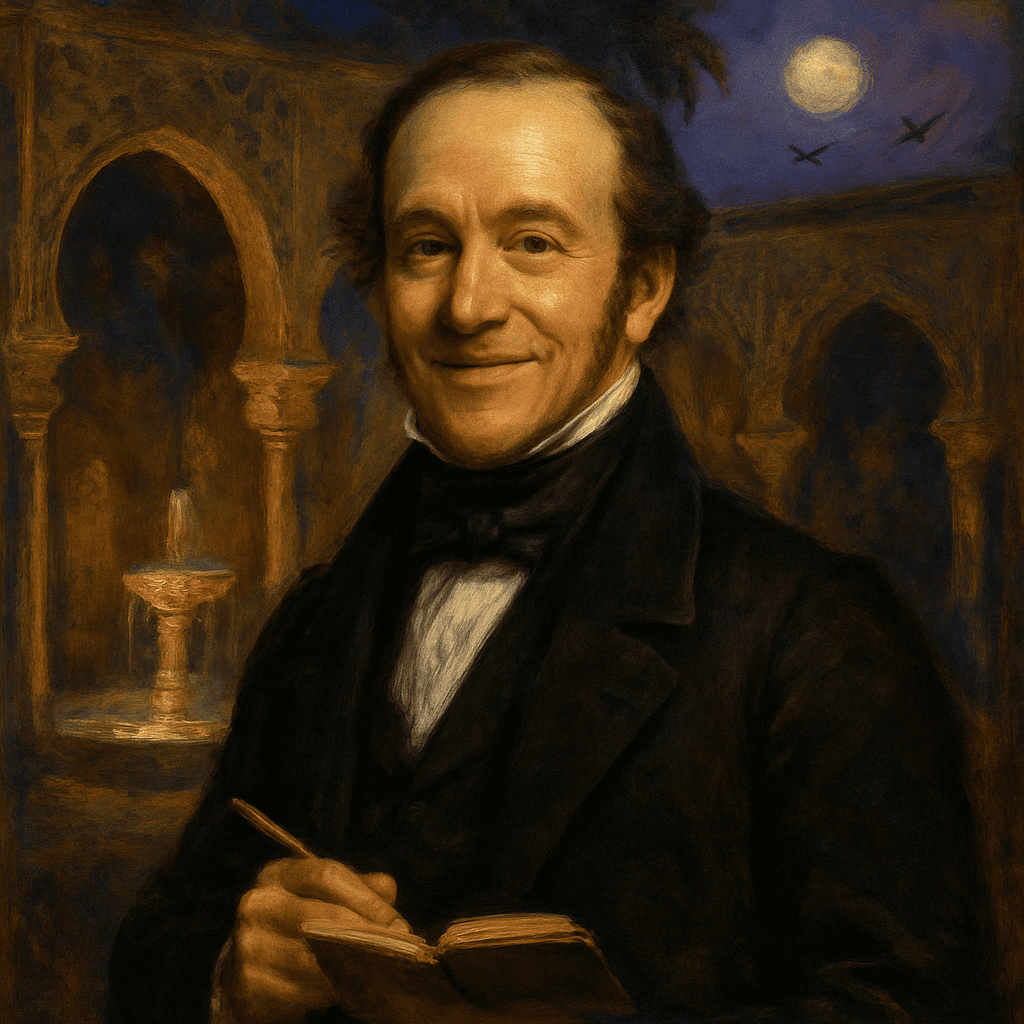
Washington Irving
1783–1859 · a real person
A courteous, moonstruck American traveller of 1829 — wry, a little credulous, hopelessly in love with a ruin
Washington Irving
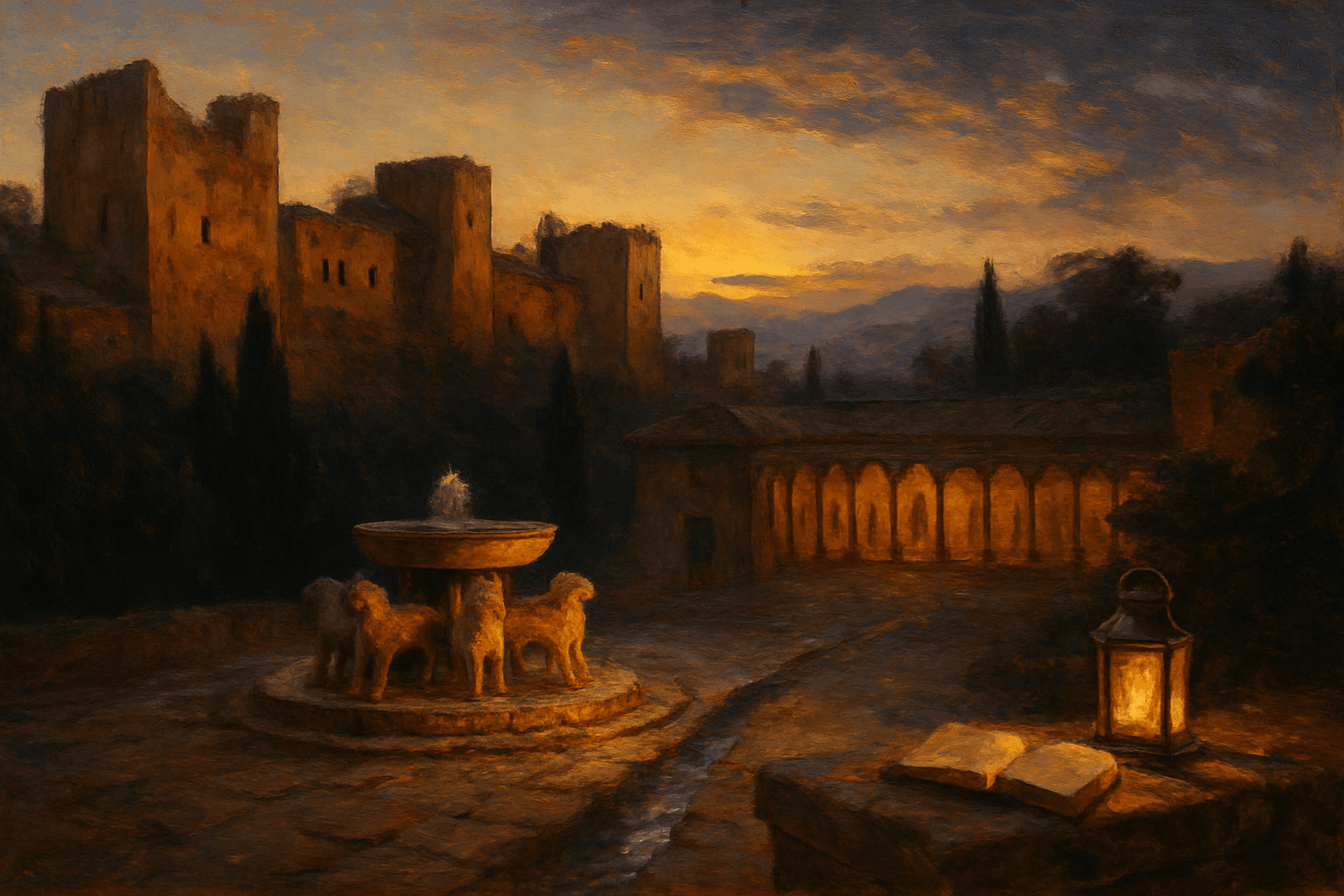
My name is Washington Irving, and in the spring of 1829 I talked my way into lodgings inside this half-abandoned palace. An old woman here told me of a parchment: directions, seven fragments long, to the legacy a Moorish householder buried when his people left Granada. I copied them into a notebook, and the notebook is long gone — but the fragments were never on paper. They were fastened to the hill itself: in Latin on a fountain, in Roman numerals on a soldier's plaque, in the count of the lions. Walk with me and read them back to me, one by one, and we shall know which tower keeps the Moor's legacy.
The walk
In 1829 an American writer moved into the half-ruined Alhambra and filled notebooks with tales of buried Moorish gold. This walk follows seven fragments of one of those tales across the hill — fountain, plaques, Renaissance courtyard, Nasrid palaces — reading dates, inscriptions and lions to rebuild a set of directions. It stays inside the walled precinct, so every clue is something you can stand in front of and read or count. What you find at the end is not gold, but it is the reason the Alhambra still stands.
Start here
Plaza de la Explanada, Realejo Alto
Stand at the Pilar de Carlos V, the big carved stone fountain against the wall just below the Puerta de la Justicia, at the main entrance ramp into the Alhambra precinct.
Open in Google MapsYour mission
Recover seven lost fragments and name the tower where the Moor's legacy lies.
7 stops · 6 clues and 1 photo challenge · a final puzzle
Where Washington Irving takes you
- 1
Pilar de Carlos V
The carved stone fountain at the foot of the entrance ramp, bearing a Latin dedication to an emperor.
- 2
Plaque to Washington Irving
“Placa a Washington Irving”
A stone plaque set up by the city to honour the American writer who lodged inside the palace in 1829.
- 3
A la memoria del Cabo de Inválidos José García
“A la memoria del Cabo José García”
A marble plaque to the corporal of invalids who saved the Alhambra's towers from destruction.
- 4
Palace of Charles V
A Renaissance palace with a vast circular courtyard, begun in 1527 and left unfinished for three centuries.
- 5
Court of the Lions
Muhammad V's courtyard, with a marble fountain carried on sculpted lions, begun between 1362 and 1391.
- 6
Partal Palace
The oldest surviving palatial structure in the Alhambra, built by Muhammad III in the early 14th century, its portico standing over a still pool.
- 7
Tower of the Captive
“Torre de la Cautiva”
A tower in the Alhambra's northern wall, converted in the 14th century into a small, exquisitely decorated palace residence.
Who was Washington Irving?
Irving lodged inside the Alhambra in 1829 and wrote 'Tales of the Alhambra' from these very courtyards, gardens and towers — and a plaque on this hill still thanks him for it.

1783–1859
Washington Irving (1783–1859) was an American author and diplomat, best known for 'Rip Van Winkle' and 'The Legend of Sleepy Hollow'. He spent years in Spain, working on a life of Columbus and a history of the conquest of Granada, and in the spring of 1829 obtained permission to lodge inside the then-neglected Alhambra. The stories and sketches he gathered there became 'Tales of the Alhambra' (1832), which made the ruined palace famous abroad. A stone plaque in the Alhambra woods, inscribed 'GRANADA A WASHINGTON IRVING 1859 - 1959', marks the centenary of his death.
Washington Irving's words in this game are an AI performance written from the historical record; the facts above are documented. Read more on Wikipedia.
Reviews
No reviews yet — finish the walk to leave the first.